
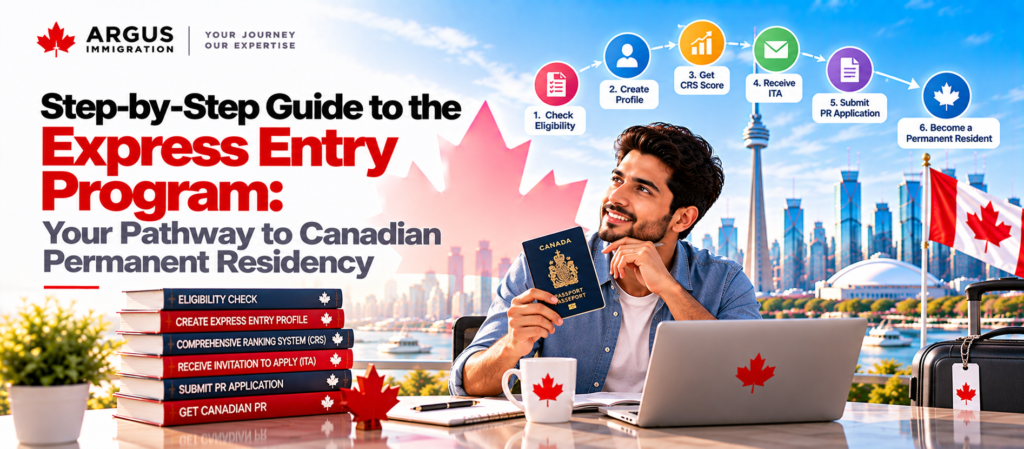
Canada remains a popular destination for skilled immigrants from around the world. It offers career opportunities, a diverse society, and a high standard of living. As a result, many people want to make Canada their permanent home.
The Express Entry program is one of Canada’s main pathways for skilled workers seeking permanent residence (PR). However, the process involves several steps, from checking your eligibility to submitting a complete application.
This guide explains how the Express Entry system works. You’ll also learn how to prepare your documents, understand your CRS score, and improve your chances of receiving an Invitation to Apply (ITA).
1. Understand the Express Entry System
Express Entry is an online system managed by Immigration, Refugees and Citizenship Canada (IRCC). It manages applications for three economic immigration programs.
These programs are:
- Federal Skilled Worker Program (FSWP): For eligible skilled workers with qualifying work experience.
- Federal Skilled Trades Program (FSTP): For eligible workers in qualifying skilled trades.
- Canadian Experience Class (CEC): For eligible skilled workers with qualifying Canadian work experience.
Although these programs use the same application management system, each has different eligibility requirements.
For example, the FSWP may suit skilled workers with foreign work experience. In contrast, the CEC may suit candidates who have already gained eligible work experience in Canada. Meanwhile, the FSTP focuses on qualifying skilled trades.
Therefore, your first step is to identify which program matches your background.
2. Check Your Express Entry Eligibility
Before creating your profile, review the requirements for each program. Your eligibility depends on factors such as work experience, language ability, education, and other program-specific conditions.
Federal Skilled Worker Program (FSWP)
The FSWP is designed for eligible skilled workers with qualifying work experience.
Generally, applicants must meet requirements related to:
- Skilled work experience in an eligible occupation.
- English or French language proficiency.
- Education and, where applicable, an Educational Credential Assessment (ECA).
- A minimum score on the FSWP selection grid.
- Proof of funds, unless an exemption applies.
Applicants must generally score at least 67 out of 100 points on the FSWP selection grid to meet this program’s selection requirement. However, meeting that threshold does not guarantee an invitation to apply.
Federal Skilled Trades Program (FSTP)
The FSTP is intended for eligible workers in specific skilled trades.
Applicants generally need to meet requirements involving:
- Qualifying work experience in an eligible skilled trade.
- Required English or French language scores.
- A qualifying job offer or a Canadian certificate of qualification, subject to program rules.
The exact requirements depend on your circumstances. Therefore, check the current IRCC criteria before applying.
Canadian Experience Class (CEC)
The CEC is designed for skilled workers who have gained eligible work experience in Canada.
To qualify, applicants generally need:
- At least one year of qualifying Canadian work experience within the relevant three-year period.
- Language test results that meet the requirements for their occupation’s TEER category.
- Work experience that meets IRCC’s rules for the CEC.
An ECA is not a universal CEC requirement. However, an assessment may help if you want to claim points for foreign education.
Important: Meeting the minimum eligibility requirements allows you to enter the Express Entry pool. It does not guarantee an ITA.
3. Understand Your CRS Score
Once you qualify for Express Entry and submit your profile, IRCC ranks you using the Comprehensive Ranking System (CRS).
Your CRS score helps determine your position in the candidate pool. IRCC considers several factors, including age, education, language proficiency, work experience, and certain additional qualifications.
The CRS has a maximum score of 1,200 points. However, your actual score depends on your personal circumstances and the applicable scoring rules.
Age and education
Age can affect your CRS score. Younger candidates generally receive more age-related points than older candidates.
Education also plays an important role. For example, a higher level of education may help you earn more points, provided you meet the relevant requirements.
Work experience
Both Canadian and foreign work experience can contribute to your score.
Canadian work experience may increase your CRS score directly. In addition, a combination of foreign work experience, language proficiency, and other qualifying factors may earn skill transferability points.
Therefore, review your complete profile instead of focusing on one factor alone.
Language proficiency
English and French language results can significantly affect your CRS score.
For example, improving your language test results may increase your core points. It may also help you qualify for additional points under certain combinations of skills and experience.
Strong French proficiency can provide further opportunities through applicable French-language selection categories.
How can you check your CRS score?
You can use IRCC’s official CRS calculator to estimate your score.
After calculating it, compare your score with recent invitation rounds that match your profile. However, remember that previous cut-off scores do not guarantee the outcome of future draws.
4. Prepare Your Express Entry Documents
After confirming your eligibility, start collecting the required documents. Preparing early can help you avoid unnecessary delays later.
Use an Express Entry document checklist to organize your records and identify anything you still need.
Identity documents
Prepare the following documents, as applicable:
- A valid passport or travel document.
- Identity and civil status documents.
- Police certificates when required.
- Medical examination information or results, according to IRCC instructions.
Education documents
Your education documents may include:
- Degree certificates and educational transcripts.
- An Educational Credential Assessment (ECA), if required or if you need it to claim education points.
An ECA helps establish how your foreign education compares with Canadian educational standards.
Work experience documents
Collect employment records that support the work experience you claim.
These may include:
- Employer reference letters.
- Employment dates and job duties.
- Supporting employment or salary records, where appropriate.
- A valid job offer, if relevant to your application.
Make sure your documents accurately reflect your actual work history.
Language test results
You must take an approved language test if your program requires it.
Common approved tests include IELTS General Training and CELPIP-General for English, as well as TEF Canada and TCF Canada for French.
Check the current IRCC list before booking a test. Also, confirm that your results will remain valid when required.
Proof of funds and other documents
Some applicants must demonstrate that they have enough money to support themselves and their family in Canada.
However, proof-of-funds requirements depend on the immigration program and the applicant’s circumstances. For example, qualifying CEC applicants generally do not need to provide proof of funds for the program.
Before submitting your application, verify every document requirement on the official IRCC website. Missing, inconsistent, or inaccurate information can cause delays or lead to a refusal.
5. Create Your Express Entry Profile
Once you have checked your eligibility and gathered the necessary information, you can create your Express Entry profile through IRCC’s official online system.
Follow these steps:
- Sign in to your IRCC account or create one if needed.
- Enter your personal and family information.
- Provide details about your education and work experience.
- Enter your language test results.
- Include other information required by the system.
- Review your answers and submit your profile.
IRCC generally gives you 60 days to complete and submit an Express Entry profile after you start it. Therefore, prepare your information before beginning the process.
Make sure every answer is accurate. Your profile should match the supporting documents you may need to provide later.
After you submit an eligible profile, IRCC places it in the Express Entry pool. The system then ranks eligible candidates using the CRS.
Keep in mind that entering the pool does not automatically mean you will receive an invitation.
6. Wait for an Invitation to Apply (ITA)
After entering the Express Entry pool, you must wait for an invitation to apply for permanent residence.
IRCC conducts invitation rounds throughout the year. The frequency, type, and selection criteria can vary.
For example, IRCC may conduct general rounds, program-specific rounds, or category-based rounds for eligible candidates.
If IRCC invites you, it will issue an ITA through your account. Your chances of receiving one depend on the applicable draw criteria, your eligibility, your CRS score, and the number of invitations issued.
What if your CRS score is below the cut-off?
Do not assume that your immigration journey has ended.
Instead, review your profile and identify ways to improve your score. You may be able to increase your language results, gain additional qualifying work experience, or explore a suitable provincial nomination pathway.
You should also keep your profile information current.
How long does an Express Entry profile remain valid?
An Express Entry profile generally remains active for up to 12 months, unless you receive an invitation or another event affects its status.
If your profile expires before you receive an ITA, you may need to submit a new profile if you remain eligible.
Therefore, keep track of your profile’s expiry date and update your information when your circumstances change.
7. Submit Your Permanent Residence Application
Receiving an ITA is an important milestone. However, you must still submit a complete permanent residence application within the deadline shown in your IRCC account.
The deadline is generally 60 days from the date of the invitation. Always follow the specific instructions in your account.
What should your application include?
Your application may require:
- Completed online application forms.
- Identity and civil status documents.
- Proof of work experience and education.
- Valid language test results.
- Police certificates.
- Medical examination information.
- Proof of funds, if applicable.
- Other supporting documents requested by IRCC.
- Payment of the applicable fees.
Before submitting, compare your application with your Express Entry profile. Your information must be accurate and consistent.
If your circumstances have changed since you received your ITA, check how those changes affect your eligibility and CRS score. Do not assume that every change is harmless.
Understand application fees
Express Entry fees can change over time. The total amount also depends on your application and family composition.
You may need to pay a processing fee, a right of permanent residence fee, and additional charges for accompanying family members or other services.
Consequently, check the current IRCC fee schedule before making a payment. Avoid relying on older blog posts for exact fee amounts.
Once you submit your application, IRCC will provide confirmation that it has received it. This is commonly called an Acknowledgement of Receipt (AOR).
Afterward, monitor your account for updates and respond promptly to any requests.
8. Understand Processing Times and Final Steps
After you submit your permanent residence application, IRCC begins processing it.
IRCC has historically aimed to process many complete Express Entry applications within six months. However, this is not a guarantee for every applicant.
Processing times can vary depending on the application, background checks, document verification, and other factors.
During processing, IRCC may request biometrics, additional documents, or further information. Therefore, check your account and email regularly.
What happens after approval?
If IRCC approves your application, you will receive the relevant confirmation documents.
Depending on your circumstances, these may include a Confirmation of Permanent Residence (COPR) and a permanent resident visa, if required.
Follow the instructions in your approval letter to complete the process and become a permanent resident of Canada.
9. How to Improve Your CRS Score
If your CRS score is lower than the cut-off scores in relevant invitation rounds, consider the options available to you.
The right strategy depends on your profile. However, the following approaches may help.
Improve your language test results
Language proficiency can influence several parts of your CRS score.
For example, a stronger score in English or French may increase your core points. It may also improve your eligibility for additional points through applicable combinations of qualifications.
Therefore, consider retaking an approved language test if you can realistically improve your results.
Explore provincial nomination opportunities
Provincial Nominee Programs (PNPs) allow participating provinces and territories to nominate eligible candidates who meet their program requirements.
Some PNP streams connect with Express Entry. A qualifying nomination through an enhanced Express Entry stream can add 600 CRS points.
However, each province sets its own requirements. Check whether your occupation, experience, and background match an available stream before applying.
Gain additional qualifying work experience
Additional eligible work experience may strengthen your profile.
Depending on your circumstances, Canadian work experience can improve your CRS score. Foreign work experience may also help, particularly when combined with strong language results or other qualifying factors.
However, only experience that meets the relevant IRCC rules will count.
Consider further education
Additional education may improve your CRS score in some circumstances.
Before enrolling in a course, compare the potential benefits with the tuition fees, time commitment, and other costs. Also, confirm that the qualification will count under the applicable CRS rules.
Explore category-based selection
IRCC may conduct category-based invitation rounds for candidates who meet specific criteria.
These categories can change over time. Therefore, check the current categories and eligibility rules on the official IRCC website.
The key is to develop a strategy that fits your qualifications rather than relying on one possible route.
10. Why Consider Professional Immigration Guidance?
Express Entry involves eligibility requirements, document preparation, CRS calculations, and application deadlines. As a result, some applicants prefer professional support.
A qualified immigration professional can help you understand the process and identify potential issues before you submit your application.
For example, professional guidance may help you:
- Assess your eligibility for an applicable immigration program.
- Review your work experience and supporting documents.
- Understand how different factors affect your CRS score.
- Identify potentially suitable provincial nomination pathways.
- Prepare your application and respond to document requests.
However, professional assistance does not guarantee an ITA or approval.
If you choose to seek advice, verify the professional’s credentials and authorization to provide Canadian immigration services.
11. Express Entry Canada for Indian Applicants
Express Entry is available to eligible applicants from many countries, including India.
If you are an Indian professional planning to move to Canada, you should begin by checking your eligibility. Your nationality alone does not determine whether you qualify.
Instead, IRCC assesses factors such as your work experience, language proficiency, education, and other program-specific requirements.
Start by obtaining the required language test results and arranging an ECA if needed. Then, calculate your CRS score and explore the immigration pathways that suit your profile.
Additionally, review current invitation rounds and provincial nomination opportunities. These steps can help you understand your options before committing time and money to the process.
12. How to Apply for Canadian PR from the UAE
You can explore Express Entry even if you currently live in the United Arab Emirates.
Applicants living in the UAE must meet the same applicable Express Entry program requirements as other candidates. Living or working abroad does not automatically make someone eligible for permanent residence.
First, check whether you qualify for the FSWP, FSTP, or CEC. Then, prepare your language test results, education documents, and work experience records.
If you completed your education outside Canada, you may need an ECA to claim education points or meet the relevant program requirements.
You should also review proof-of-funds requirements, if applicable. Finally, submit your profile through IRCC’s official system if you meet the eligibility criteria.
13. Express Entry Processing Time and Application Fees
Processing times and fees are important parts of your immigration plan.
As explained earlier, IRCC has historically aimed to process many complete Express Entry applications within six months. Nevertheless, actual processing times can differ from one application to another.
Similarly, application fees depend on the current fee schedule and the people included in your application.
You may need to budget for:
- Language testing.
- Educational Credential Assessment.
- Police certificates.
- Medical examinations.
- Immigration application fees.
- Biometrics, where applicable.
- Other document-related expenses.
Therefore, prepare a realistic budget before you apply. Check IRCC’s official processing-time tool and fee schedule for the latest information.
Your Trusted Partner for Express Entry Guidance — Argus Immigration Consultancy
Planning your Canadian permanent residence application can feel complicated. However, the right information and preparation can make the process easier to understand.
Argus Immigration Consultancy helps individuals and families explore Canadian immigration pathways. Our team can help you understand the Express Entry process, review your profile, organize documents, and explore suitable options based on your circumstances.
Whether you are considering the FSWP, FSTP, CEC, or an applicable provincial nomination pathway, understanding your options is an important first step.
Contact Argus Immigration Consultancy to discuss your circumstances and learn more about the support available for your Canadian immigration journey.
Conclusion
The Express Entry program provides a pathway to Canadian permanent residence for eligible skilled workers. However, success requires more than creating a profile.
First, identify the immigration program that matches your background. Next, prepare the required documents and submit an accurate Express Entry profile.
After entering the pool, monitor your CRS score and review relevant invitation rounds. If you receive an ITA, submit a complete application before the deadline.
Meanwhile, continue checking official IRCC updates because eligibility requirements, invitation categories, fees, and processing times can change.
Ready to explore your Canadian PR options? Start by assessing your eligibility, calculating your CRS score, and building a plan that suits your qualifications and long-term goals.