Are you working in Canada and hoping to become a permanent resident? The Canadian Experience Class (CEC) could be a suitable pathway for you.
The CEC is part of Canada’s Express Entry system. It helps eligible skilled workers with Canadian work experience apply for permanent residence. For example, international graduates and temporary foreign workers may qualify if they meet the program requirements.
However, Canadian work experience alone does not guarantee eligibility. You must also meet specific work experience and language requirements.
In this guide, you’ll learn how to qualify for the Canadian Experience Class program. We’ll also explain the required documents, ways to improve your CRS score, and the steps involved in applying for permanent residence.
What Is the Canadian Experience Class?
The Canadian Experience Class is one of three immigration programs managed through Express Entry.
The other two programs are:
- Federal Skilled Worker Program (FSWP): For eligible skilled workers with qualifying work experience.
- Federal Skilled Trades Program (FSTP): For eligible workers in qualifying skilled trades.
- Canadian Experience Class (CEC): For eligible skilled workers with qualifying Canadian work experience.
Each program has different eligibility requirements. Therefore, you should check which program best matches your background before creating your Express Entry profile.
The CEC is especially relevant to people who have already gained eligible skilled work experience in Canada and want to apply for permanent residence.
Canadian Experience Class Eligibility Requirements
To qualify for the CEC, you must meet IRCC’s requirements for work experience, language ability, and other conditions.
Let’s look at the main requirements.
1. Gain Qualifying Work Experience in Canada
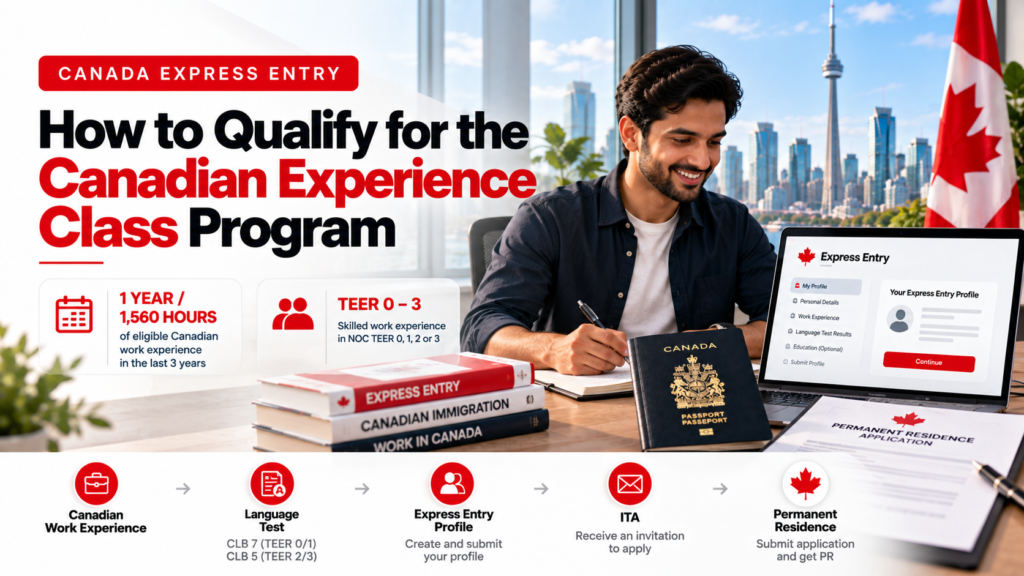
You generally need at least one year of qualifying skilled work experience in Canada within the three years before you apply.
This usually means completing 1,560 hours of eligible work. You can gain this experience through full-time or equivalent part-time work, subject to IRCC’s rules.
Your work experience must also meet these conditions:
- You must have been legally authorized to work in Canada.
- Your occupation must fall under an eligible NOC TEER category.
- Your duties must match the requirements for the occupation you claim.
- You must meet the applicable rules for counting work hours.
The CEC generally accepts qualifying work in occupations classified under TEER 0, 1, 2, or 3.
However, not every type of Canadian work counts. For example, work completed while you were a full-time student generally does not count toward the CEC minimum work experience requirement.
Therefore, review your employment history carefully before applying.
2. Meet the Language Requirements
You must take an approved English or French language test and meet the minimum level for your occupation’s TEER category.
The minimum requirements are:
- TEER 0 or 1 occupations: Canadian Language Benchmark (CLB) 7 or equivalent.
- TEER 2 or 3 occupations: CLB 5 or equivalent.
Approved tests include IELTS General Training and CELPIP-General for English. For French, you can take TEF Canada or TCF Canada.
Your results must meet the required level in each language ability. In addition, your test results must remain valid when you submit your application.
If your scores fall below the required level, consider retaking the test before applying.
3. Meet the Work Authorization Rules
Your qualifying Canadian work experience must meet IRCC’s rules.
In general, you must have obtained the experience while legally authorized to work in Canada. Your work must also meet the CEC’s requirements for eligible employment.
Before applying, review your work permit conditions and employment records. This can help you identify whether your experience counts toward the program.
4. Plan to Live Outside Quebec
The Canadian Experience Class is a federal immigration program. Applicants must plan to live outside Quebec.
If you intend to settle in Quebec, you should explore the immigration pathways available through the province.
Therefore, consider your preferred destination before choosing an immigration program.
Documents Required for the Canadian Experience Class
Preparing your documents early can make the application process easier. It also helps you identify missing information before you receive an invitation to apply.
Depending on your circumstances, you may need the following documents:
- Proof of work experience: Employer reference letters and supporting employment records.
- Language test results: Valid results from an approved English or French test.
- Identity documents: A valid passport and other required identity records.
- Police certificates: Certificates required for your application.
- Medical examination: Medical information or examination results, as instructed by IRCC.
- Education documents: Records that may support your CRS score or other parts of your application.
- Biometrics: Fingerprints and a photograph, if IRCC requires them.
Your employer reference letters should accurately describe your job duties, employment dates, and other relevant details.
In addition, make sure your documents match the information in your Express Entry profile.
Do CEC Applicants Need Proof of Funds?
Generally, applicants under the Canadian Experience Class do not need to provide proof of settlement funds.
However, you must still meet the other applicable requirements and provide any documents IRCC requests.
Key Benefits of Applying Through the CEC
The Canadian Experience Class offers several benefits for eligible workers.
1. No Proof of Funds Requirement
CEC applicants generally do not need to show proof of settlement funds.
As a result, this requirement may be simpler than it is for some other economic immigration programs.
2. Canadian Work Experience Counts
The program focuses on qualifying skilled work experience gained in Canada.
Therefore, it may suit workers who have already established themselves in the Canadian labour market.
3. International Graduates May Qualify
International graduates may become eligible if they gain the required qualifying Canadian work experience after graduation.
For example, some graduates obtain work authorization through a Post-Graduation Work Permit (PGWP). However, a PGWP does not automatically make someone eligible for the CEC.
You must still meet the work experience, language, and other program requirements.
4. Canadian Experience Can Improve Your CRS Score
Canadian work experience can contribute to your Comprehensive Ranking System (CRS) score.
Additionally, certain combinations of work experience, education, and language ability may help you earn more points.
However, the number of points you receive depends on your individual circumstances.
How to Improve Your CRS Score for the CEC
Meeting the CEC eligibility requirements does not guarantee an invitation to apply. Express Entry ranks eligible candidates using the CRS.
If your score is lower than the cut-off in relevant invitation rounds, consider the following options.
1. Improve Your Language Test Results
Language ability can make a significant difference to your CRS score.
For example, improving your English or French results may increase your core points. It may also help you earn additional points through applicable combinations of skills.
Therefore, consider retaking an approved language test if you can improve your results.
2. Claim Eligible Education Points
Education can contribute to your CRS score.
If you completed your education outside Canada, you may need an Educational Credential Assessment (ECA) to claim points for that qualification.
However, an ECA is not a universal CEC eligibility requirement. Check the applicable rules before arranging an assessment.
3. Review Your Spouse’s Factors
If your spouse or common-law partner is included in your application, certain factors related to their education, language ability, and Canadian work experience may affect your CRS calculation.
Review the CRS rules carefully to understand how these factors apply to your circumstances.
4. Explore Provincial Nominee Programs
Some provinces and territories offer nomination pathways connected to Express Entry.
If you receive a qualifying nomination through an enhanced provincial stream, you can gain 600 additional CRS points.
However, each province has its own requirements. Check the available streams to determine whether your occupation and experience match their criteria.
5. Monitor Category-Based Invitation Rounds
IRCC may invite candidates who meet the requirements for specific selection categories.
These categories and their criteria can change over time. Therefore, check current IRCC announcements and review whether you qualify.
Step-by-Step Guide to Applying for the CEC
Once you understand the eligibility requirements, you can begin preparing for Express Entry.
Follow these steps to organize your application.
Step 1: Check Your Eligibility
First, confirm that you meet the CEC work experience and language requirements.
Review your employment records and make sure your qualifying work experience falls within the relevant period.
Step 2: Prepare Your Information
Next, gather your language test results, passport details, work history, and other information required to create your profile.
Preparing these details early can help you avoid mistakes.
Step 3: Create an Express Entry Profile
Submit your Express Entry profile through the official IRCC system.
Enter your information accurately, including your work experience, education, and language results.
Once you submit an eligible profile, IRCC places you in the Express Entry pool.
Step 4: Wait for an Invitation to Apply
IRCC ranks eligible candidates using the CRS. It then issues invitations through different types of invitation rounds.
If you receive an Invitation to Apply (ITA), review the instructions in your IRCC account immediately.
Remember that entering the pool does not guarantee an invitation.
Step 5: Submit Your Permanent Residence Application
After receiving an ITA, complete and submit your permanent residence application within the deadline shown in your account.
The usual deadline is 60 days from the invitation date. However, always follow the specific instructions provided by IRCC.
Upload the required documents and pay the applicable fees before submitting.
Step 6: Complete Biometrics and Medical Requirements
IRCC may require biometrics, a medical examination, or additional documents.
Follow the instructions and complete each requirement within the stated deadline.
Also, check your account regularly for updates.
Step 7: Receive a Decision on Your Application
IRCC will assess your application and supporting documents.
If your application is approved, you will receive the relevant confirmation documents and instructions for completing the permanent residence process.
Processing times vary, so avoid relying on a fixed timeline.
Common CEC Application Mistakes to Avoid
Small mistakes can create unnecessary problems during the immigration process. Fortunately, careful preparation can help you avoid many of them.
1. Selecting the Wrong NOC Code
Your NOC code must match your actual job duties.
A similar job title is not enough. Instead, compare your responsibilities with the official occupational description.
2. Submitting Incomplete Reference Letters
Employer letters should contain accurate details about your employment and duties.
If important information is missing, IRCC may ask for additional evidence or question whether your experience qualifies.
3. Using Expired Language Test Results
Your language test results must meet IRCC’s validity rules when required.
Therefore, check the expiry date before creating your profile and again before submitting your application.
4. Counting Ineligible Work Experience
Not every type of Canadian work counts toward the CEC minimum.
For example, work completed while studying full-time generally does not count toward this requirement. Review IRCC’s rules before calculating your eligible hours.
5. Forgetting to Update Your Profile
Your circumstances may change while you are in the Express Entry pool.
For instance, you may gain additional work experience, receive new language results, or experience a change in marital status.
Update your profile when necessary. Accurate information helps ensure that your profile reflects your current circumstances.
Why Work With an Immigration Consultant?
Express Entry involves several requirements, from selecting the correct NOC code to preparing supporting documents.
For this reason, some applicants seek professional guidance.
An authorized Canadian immigration professional may help you:
- Review your eligibility for the CEC.
- Identify the appropriate NOC code for your work experience.
- Understand your CRS score.
- Organize your supporting documents.
- Prepare your application and respond to IRCC requests.
However, professional assistance cannot guarantee an invitation or approval.
Before choosing a representative, verify their authorization to provide Canadian immigration advice.
Looking for a Canadian Experience Class Consultant Near You?
If you are searching for a Canadian Experience Class consultant near you, Argus Immigration Consultancy can help you explore your options.
Our team can help you understand the CEC requirements, review your circumstances, and prepare for the next steps in the Express Entry process.
Whether you are a temporary foreign worker or an eligible international graduate, the first step is to understand how your experience fits the program’s requirements.
Visit our contact page to discuss your Canadian immigration plans.
Final Thoughts
The Canadian Experience Class offers a pathway to permanent residence for eligible skilled workers with Canadian work experience.
However, qualifying for the program requires more than working in Canada for one year. You must also meet the language requirements and follow the rules for eligible work experience.
Start by reviewing your employment history and checking your language results. Next, prepare your Express Entry profile and monitor relevant invitation rounds.
Meanwhile, keep your documents accurate and your information up to date.
Planning to apply for permanent residence through the CEC? Contact Argus Immigration Consultancy to explore your options and prepare for the next steps in your Canadian immigration journey.