Canada is a popular destination for people who want to build a better future. It offers career opportunities, educational options, and a diverse society. However, moving to Canada permanently requires careful planning and the right immigration pathway.
If you want to become a Canadian permanent resident, you first need to understand the available programs and their eligibility requirements. Fortunately, Canada offers several pathways for skilled workers, international graduates, eligible family members, and other applicants.
In this guide, you will learn how to get permanent resident status in Canada, which programs you can explore, and how to prepare your application.
What Is Permanent Residence in Canada?
Canadian permanent residence (PR) allows eligible foreign nationals to live in Canada permanently. Permanent residents can generally work and study in Canada, access eligible social benefits, and apply for Canadian citizenship if they meet the requirements.
However, permanent residence is different from Canadian citizenship. For example, permanent residents cannot vote in federal elections or hold certain government positions that require citizenship.
Permanent residents must also meet Canada’s residency obligation to maintain their status. Therefore, it is important to understand your responsibilities after receiving PR.
What Are the Main Ways to Get Permanent Residence in Canada?
Canada offers several immigration pathways. The right option depends on your education, work experience, language skills, family connections, and other circumstances.
1. Express Entry
Express Entry is an online system that manages applications from skilled workers. It covers three federal immigration programs:
- Federal Skilled Worker Program (FSWP): For eligible skilled workers with qualifying work experience.
- Canadian Experience Class (CEC): For eligible skilled workers with Canadian work experience.
- Federal Skilled Trades Program (FSTP): For qualified workers in eligible skilled trades.
First, you must meet the requirements of an eligible program. Then, you can create an Express Entry profile and enter the candidate pool.
Eligible candidates receive a Comprehensive Ranking System (CRS) score. IRCC ranks candidates and issues invitations during invitation rounds. If you receive an invitation, you can submit an application for permanent residence.
However, creating a profile does not guarantee an invitation. Your eligibility and chances of receiving an invitation depend on the program rules and selection process.
2. Provincial Nominee Program (PNP)
The Provincial Nominee Program allows participating provinces and territories to nominate candidates who meet their regional immigration needs.
For example, a province may look for skilled workers, people with specific work experience, or applicants who intend to establish their lives there.
Each province and territory sets its own eligibility requirements. Consequently, you should review the official rules before choosing a stream.
There are two main application routes:
- Express Entry PNP: For candidates who qualify for both an eligible provincial stream and an Express Entry program.
- Non-Express Entry PNP: For candidates applying through a provincial stream outside the Express Entry process.
A provincial nomination can strengthen an eligible Express Entry profile. Nevertheless, you must meet the applicable requirements and complete the required federal application steps.
3. Family Sponsorship
Family sponsorship may be an option if you have an eligible family member in Canada.
Canadian citizens and permanent residents may qualify to sponsor certain relatives, including a spouse, common-law partner, or dependent child. Other family sponsorship options have separate eligibility rules and may have limited availability.
For instance, a sponsor must meet the requirements for their relationship and category. The person being sponsored must also meet the applicable immigration requirements.
Therefore, check the current family sponsorship rules before preparing an application. Not every family relationship qualifies for sponsorship.
4. Regional Immigration Programs
Some Canadian immigration programs focus on particular regions and communities. These pathways aim to attract eligible newcomers who can contribute to local economies and communities.
Depending on your circumstances, you may explore options such as:
- Atlantic Immigration Program
- Rural Community Immigration Pilot
- Francophone Community Immigration Pilot
- Other eligible regional or community-based pathways
Each program has its own requirements. Some may require a qualifying job offer, support from a designated employer, relevant work experience, language proficiency, or an intention to live in a particular community.
Because program availability can change, always confirm that the pathway is open and that you meet its current requirements.
What Are the Basic Eligibility Requirements for Canadian PR?
There is no single eligibility checklist for every permanent residence program. However, many economic immigration pathways assess some of the following factors.
Education
Your education can affect your eligibility and ranking. Some programs require a minimum level of education, while others use education to award selection points.
If you completed your education outside Canada, you may need an Educational Credential Assessment (ECA) for certain programs.
An ECA helps establish how your foreign qualification compares with a Canadian credential. However, not every immigration pathway requires one.
Work Experience
Your work experience can also affect your eligibility. The relevant requirements depend on the program, occupation, duties, and period of employment.
For skilled immigration, you should identify the correct National Occupational Classification (NOC) code based on your actual job duties. A job title alone may not accurately describe your occupation.
Therefore, review the official NOC description and compare it with your work history before submitting your profile.
Language Proficiency
English or French language skills play an important role in many immigration pathways.
You may need to take an approved language test and meet the minimum score for your program. Your results can also affect your eligibility or ranking.
For this reason, check which tests IRCC accepts and how long the results remain valid. If your score is below the required level, consider preparing for another test before applying.
Age and Other Factors
Some immigration selection systems consider age, education, language skills, and work experience. However, the importance of each factor varies by program.
Other requirements may include proof of funds, a qualifying job offer, a provincial nomination, or evidence of an eligible family relationship.
As a result, you should assess your full profile instead of relying on one factor alone.
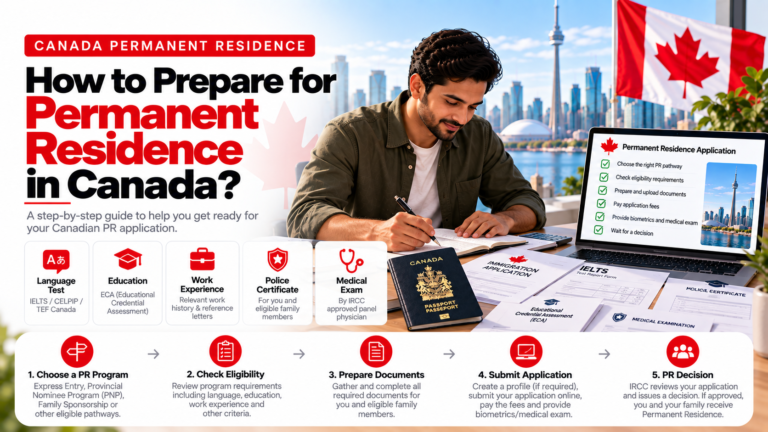
Step-by-Step Guide to Applying for Canadian PR
Once you identify a suitable pathway, follow these steps to prepare your application.
Step 1: Choose the Right Immigration Program
First, review the available programs and identify the ones that match your background.
Consider your education, work experience, language skills, family connections, and preferred province. You can also use the official IRCC immigration program explorer to discover potential options.
Step 2: Check Your Eligibility
Next, read the official eligibility requirements for your selected program.
Make sure you understand the required work experience, language scores, education, funds, and other conditions. If you are considering Express Entry, check whether you qualify for at least one of its three programs.
Remember that meeting the minimum requirements does not necessarily mean you will receive an invitation.
Step 3: Prepare Your Documents
After confirming your eligibility, collect the required documents.
Depending on your pathway, these may include:
- A valid passport or travel document.
- Approved language test results.
- Education certificates and transcripts.
- An Educational Credential Assessment, if required.
- Employment letters and work experience records.
- Proof of funds, if applicable.
- Police certificates, when required.
- Marriage or birth certificates, where relevant.
- Provincial nomination documents, if applicable.
Also, check the document checklist for your specific application. Submit accurate information and arrange translations when required.
Step 4: Create Your Profile or Submit Your Application
The next step depends on your immigration pathway.
For Express Entry, eligible applicants create an online profile and enter the candidate pool. If IRCC invites them to apply, they can submit a permanent residence application.
For other programs, you may need to apply to a province, obtain a nomination, receive support from an eligible employer, or submit a sponsorship application.
Therefore, follow the official instructions for your chosen pathway rather than assuming every program uses the same process.
Step 5: Pay the Required Fees
Applicants must pay the applicable government fees. The amount depends on the program and the people included in the application.
Additional costs may include language tests, educational assessments, medical examinations, police certificates, and document translations.
Before making payments, check the current fee schedule on the official IRCC website.
Step 6: Complete Any Additional Requirements
After you submit your application, IRCC may require biometrics, a medical examination, additional documents, or further information.
Respond to requests by the stated deadline. In addition, keep your contact details updated so you do not miss important messages.
Step 7: Wait for a Decision
Finally, monitor your application status through the appropriate online account.
Processing times vary according to the immigration program and individual circumstances. Although you can check IRCC’s published estimates, they do not guarantee a specific decision date.
If IRCC approves your application, follow the instructions it provides to confirm your permanent resident status.
How Can You Improve Your PR Application?
Careful preparation can help you avoid common errors. Although no one can guarantee approval, the following steps can help you present a complete and accurate application.
Check your information carefully. Make sure your employment history, education details, travel history, and personal information are consistent across your documents.
Improve your language score if needed. A stronger language result may help with eligibility or ranking under certain programs.
Choose the correct NOC code. Compare your actual job duties with the official occupational description instead of relying only on your job title.
Keep documents up to date. Check the validity of your passport, language test results, and other supporting documents.
Follow official instructions. Review the latest program rules before submitting your profile or application.
Most importantly, provide truthful information. Incorrect or misleading details can lead to refusal and other immigration consequences.
Common Mistakes to Avoid When Applying for Canadian PR
Many applicants face avoidable problems because they overlook important requirements. To reduce these risks, watch out for the following mistakes.
- Choosing a program without checking eligibility.
- Selecting an incorrect NOC code.
- Submitting incomplete employment records.
- Using expired language test results.
- Providing inconsistent information across documents.
- Missing application deadlines.
- Relying on outdated immigration rules.
- Assuming that a job offer or provincial nomination guarantees permanent residence.
Instead, review every requirement before submitting your application. If you are unsure about a specific rule, consult the relevant official guidance.
How Can Argus Immigration Consultancy Help?
Choosing an immigration pathway can feel complicated, especially when several programs have different eligibility rules.
Argus Immigration Consultancy can help you understand the available options and organise the next steps based on your circumstances.
Our guidance may include:
- Reviewing your education and work experience.
- Helping you understand relevant immigration pathways.
- Explaining language test and document requirements.
- Helping you understand Express Entry and provincial nomination processes.
- Identifying potential gaps in your supporting documents.
- Explaining application steps and official requirements.
However, eligibility and approval depend on the applicable immigration rules and the decision made by Canadian immigration authorities. No consultant can guarantee permanent residence.
If you are planning to apply for Canadian PR, visit Argus Immigration Consultancy to learn more about our services.
Frequently Asked Questions About Canadian Permanent Residence
How can I get permanent residence in Canada?
You must qualify for an available immigration program, such as Express Entry, a Provincial Nominee Program, an eligible family sponsorship category, or another pathway. The correct option depends on your circumstances and the program’s requirements.
Can I apply for Canadian PR without a job offer?
Yes. Some immigration programs do not require a job offer. For example, a job offer is not a general requirement for the Canadian Experience Class. However, other eligibility conditions still apply.
Is Express Entry the only way to get Canadian PR?
No. Canada offers several pathways outside Express Entry, including certain provincial programs, family sponsorship categories, and regional immigration programs.
How long does it take to get Canadian PR?
Processing times vary by program and application. Check IRCC’s official processing-time tool for the latest estimate. Keep in mind that published estimates do not guarantee when your application will be decided.
Can I apply for Canadian PR without IELTS?
Some programs accept approved language tests other than IELTS. However, many economic immigration pathways require proof of language proficiency through an accepted test. Check the rules for your specific program before booking a test.
Does a Canadian job offer guarantee permanent residence?
No. A job offer may help under certain pathways, but it does not guarantee permanent residence. You must meet the program requirements and complete the required application process.
Final Thoughts
Getting permanent residence in Canada starts with choosing the right immigration pathway. First, assess your education, work experience, language skills, and personal circumstances. Then, compare the available programs and prepare the required documents.
In addition, check official immigration updates before submitting your application. Canadian immigration rules can change, so using current information is essential.
With careful planning and accurate documentation, you can better understand your options and prepare for the next steps. If you need help reviewing your circumstances, Argus Immigration Consultancy can guide you through the available pathways.
Ready to explore your Canadian PR options? Contact Argus Immigration Consultancy to discuss your next steps.