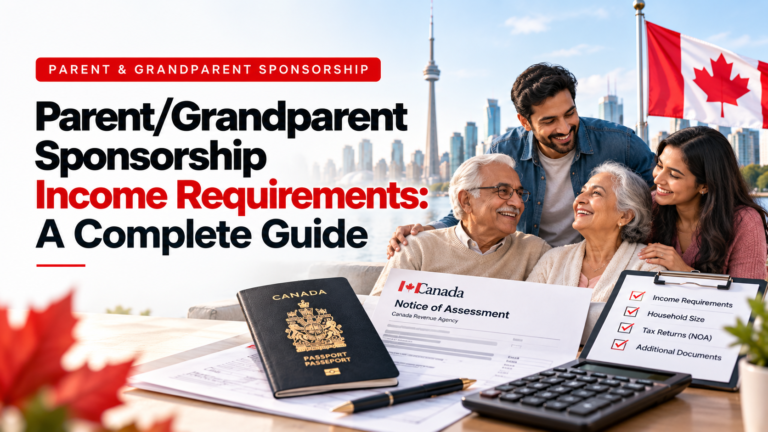
Bringing your parents or grandparents to Canada is a meaningful way to reunite your family. The Parents and Grandparents Program (PGP) allows eligible Canadian citizens and permanent residents to sponsor their loved ones for permanent residence.
As a result, parents and grandparents can build a long-term future closer to their families. However, the program has specific eligibility and income requirements.
In this guide, we’ll explain how to sponsor your parents or grandparents in 2025. You’ll learn about eligibility, the application process, income requirements, and alternative options if you aren’t selected.
1. Eligibility to Sponsor Parents or Grandparents in 2025
Before applying, make sure you meet the sponsor eligibility requirements.
Generally, you must:
- Be at least 18 years old.
- Be a Canadian citizen, permanent resident, or a person registered under the Canadian Indian Act.
- Live in Canada, subject to the applicable rules.
- Meet the Minimum Necessary Income (MNI) requirements for the required taxation years.
- Sign an undertaking to provide financial support for your sponsored family members.
The undertaking generally lasts 20 years outside Quebec and 10 years in Quebec.
Who Can You Sponsor?
The PGP allows eligible sponsors to sponsor their parents or grandparents.
Depending on the circumstances, eligible dependent family members may also be included in the application.
However, the rules for dependent children and accompanying family members can vary. Therefore, check the current IRCC instructions before submitting your application.
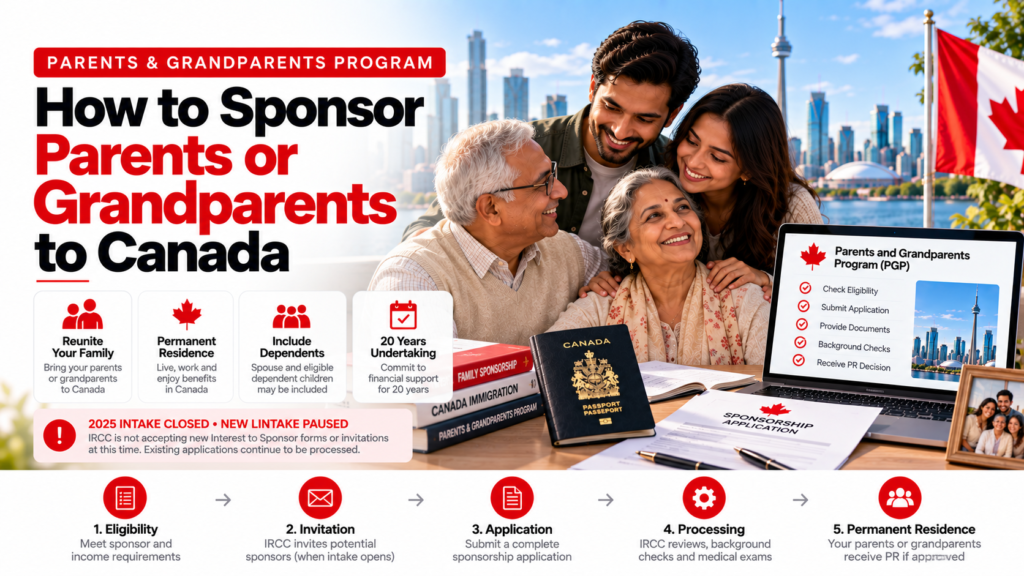
2. How Does the Parent and Grandparent Sponsorship Process Work?
The PGP uses an invitation-based process. Meeting the eligibility requirements does not automatically guarantee an invitation to apply.
Here are the main steps involved.
Step 1: Submit an Interest to Sponsor Form
When IRCC opens an intake process, eligible individuals may be able to submit an Interest to Sponsor form.
This form expresses your interest in sponsoring your parents or grandparents. However, submitting it does not guarantee that you will receive an invitation.
Step 2: Wait for an Invitation to Apply
IRCC determines how invitations are issued for each intake. Depending on the program arrangements, potential sponsors may be selected from the eligible pool.
If you receive an invitation, follow the instructions and deadline provided by IRCC.
Step 3: Prepare and Submit Your Application
Once invited, gather the required forms and supporting documents.
These may include proof of your relationship, financial records, and other documents listed in the application package.
Make sure you submit a complete application within the deadline stated in your invitation.
Step 4: Complete the Required Checks
After receiving your application, IRCC assesses your eligibility and reviews the supporting documents.
Your sponsored family members may also need to complete medical examinations and background checks.
If IRCC requests additional information, respond within the specified timeframe.
Step 5: Receive a Decision
Finally, IRCC makes a decision on your application.
If approved, your parents or grandparents can complete the permanent residence process according to IRCC’s instructions.
For the latest intake announcements and application instructions, always check the official IRCC website.
3. Income Requirements for Parent and Grandparent Sponsorship
Sponsors must demonstrate that they can financially support their parents or grandparents.
IRCC assesses financial eligibility using the Minimum Necessary Income (MNI) requirements. The required amount depends on your family size and the applicable taxation years.
Keep the following points in mind:
- You may need to demonstrate sufficient income for the three required taxation years.
- Your household size affects the income threshold.
- CRA tax records, including Notices of Assessment (NOAs), play an important role in verifying your income.
- If you have an eligible co-signer, their income may be considered under the applicable rules.
Example of Household Size
Suppose you want to sponsor both parents and your household includes you and your spouse.
Your family size may be four people. However, the correct calculation depends on your complete family circumstances and any existing sponsorship obligations.
Therefore, confirm your household size before checking the required income.
Important: Income thresholds and program instructions can change. Review the official IRCC income requirements for the relevant taxation years before applying.
4. Alternatives If You Aren’t Selected for the PGP
The PGP can be competitive, and an invitation is not guaranteed. Fortunately, other options may allow your parents or grandparents to visit Canada.
Super Visa
The Super Visa is designed for eligible parents and grandparents of Canadian citizens and permanent residents.
It can allow extended visits to Canada, subject to the applicable requirements.
Key features include:
- Longer permitted stays than a standard visitor visa.
- Multiple entries during the visa’s validity, subject to its conditions.
- Medical insurance requirements.
- Minimum income requirements for the child or grandchild in Canada.
The Super Visa is worth considering if your main goal is to spend more time together while your parents or grandparents remain temporary residents.
Visitor Visa
A Visitor Visa may suit parents or grandparents who want to visit Canada for a shorter period.
Depending on the circumstances, visitors are generally permitted to stay for up to six months at a time, unless their authorized stay specifies otherwise.
However, the visa itself does not guarantee entry or a particular length of stay.
Other Immigration Pathways
Your parents or grandparents may also explore other immigration programs if they independently meet the eligibility requirements.
For example, certain economic immigration pathways may be available to people who qualify based on factors such as work experience, education, language ability, or a provincial nomination.
However, these programs have separate requirements and are not specifically designed to sponsor parents or grandparents.
5. PGP vs. Super Visa vs. Visitor Visa
Each option serves a different purpose. Use this comparison to understand the main differences.
| Feature | PGP | Super Visa | Visitor Visa |
|---|---|---|---|
| Immigration status | Permanent residence | Temporary resident | Temporary resident |
| Main purpose | Long-term family reunification | Extended family visits | Shorter visits |
| Length of stay | Permanent, subject to maintaining status | Extended stays under applicable rules | Generally up to six months per entry, subject to authorization |
| Income requirements | Sponsor must meet applicable requirements | Host must meet applicable income requirements | Applicant must demonstrate sufficient financial support |
| Medical insurance | Not a standard PGP requirement | Required under the program rules | Generally recommended, but not a standard visitor visa requirement |
| Invitation or selection | Invitation process applies | Separate application process | Separate application process |
Processing times vary for all three options. Therefore, check the official IRCC processing-time information before making plans.
6. Tips for a Successful Sponsorship Plan in 2025
Preparing early can help you avoid common mistakes and make informed decisions.
Here are some practical steps to follow:
- Monitor IRCC announcements. Intake arrangements can change, so check official updates regularly.
- Review your income early. Make sure you understand the applicable income threshold and taxation years.
- Organize your documents. Keep your tax records, identity documents, and relationship evidence readily available.
- Check every deadline. If you receive an invitation, follow the instructions and submit your application on time.
- Consider alternative options. A Super Visa or Visitor Visa may suit your family’s needs if you aren’t selected for the PGP.
- Seek professional guidance when needed. An authorized immigration professional can help you understand your eligibility and prepare your application.
Most importantly, do not assume that submitting an interest form guarantees an invitation or that meeting the income requirements guarantees approval.
7. Frequently Asked Questions
1. How many people can I sponsor under the PGP?
Eligible sponsors may be able to sponsor their parents and grandparents, subject to the program’s rules and application arrangements. Your household size and income requirements must reflect the people covered by the sponsorship undertaking.
2. What if my income is slightly below the required threshold?
You must meet the applicable income requirements to qualify as a sponsor. If you do not qualify, consider planning for a future opportunity or exploring another option, such as a Super Visa.
3. Can I sponsor my parents if I live outside Canada?
Sponsors generally need to meet the applicable Canadian residency requirements. Permanent residents must live in Canada, while Canadian citizens living abroad must demonstrate their intention to return to Canada when their sponsored family members become permanent residents.
4. How long does PGP sponsorship take?
Processing times depend on the application, IRCC’s workload, and other factors. Check the official IRCC processing-time tool for the latest information rather than relying on a fixed estimate.
5. Can my parents switch from a Super Visa to permanent residence later?
A Super Visa does not automatically lead to permanent residence. If you later become eligible to pursue the PGP and receive an invitation, you may be able to submit a sponsorship application under the applicable rules.
Your parents must continue to meet the conditions of their temporary resident status while in Canada.
Conclusion
Sponsoring your parents or grandparents is an important step toward bringing your family closer together. However, the PGP has specific eligibility, income, and application requirements.
Start by reviewing your eligibility and organizing your financial records. Then, monitor official IRCC announcements and prepare for the relevant application process.
If you aren’t selected, a Super Visa or Visitor Visa may provide another way for your family to spend time together in Canada.
For the most accurate information, consult the official IRCC website before making a decision.
If you need help understanding your options, contact Argus Immigration to discuss your circumstances and next steps.