Reuniting with your loved one is an important goal for many families. Fortunately, Canada offers a spousal sponsorship program that helps eligible couples build their lives together.
Through this program, Canadian citizens and permanent residents can sponsor their spouse or eligible partner for permanent residence in Canada.
However, the application process involves several steps. You must meet the eligibility requirements, prepare the correct documents, and submit a complete application.
In this guide, we’ll explain the spousal sponsorship application process step by step. You’ll also learn about eligibility, processing times, common mistakes, and what happens after you apply.
1. What Is Spousal Sponsorship?
Spousal sponsorship is part of Canada’s Family Class immigration program. It allows eligible Canadian citizens and permanent residents to sponsor their spouse, common-law partner, or conjugal partner for permanent residence.
The main goal is to help families stay together in Canada.
Once your partner becomes a permanent resident, they can generally live and work in Canada. They may also study without needing a separate study permit, subject to the applicable rules.
However, approval depends on meeting the program requirements. You must also provide sufficient evidence to support your application.
2. Who Can Be Sponsored?
Canada recognizes different types of relationships under its family sponsorship rules. Your partner must meet the requirements for the relevant category.
Spouse
Your partner qualifies as a spouse if you are legally married and your marriage meets Canada’s immigration requirements.
Common-Law Partner
Your partner may qualify as a common-law partner if you have lived together in a marriage-like relationship for at least 12 consecutive months.
You must provide evidence of your shared life and cohabitation.
Conjugal Partner
A conjugal partner may qualify if you have maintained a committed relationship for at least one year but could not live together or marry because of significant circumstances beyond your control.
This category has specific requirements. Therefore, review the eligibility rules carefully before applying.
3. Eligibility Requirements for Sponsors
Before starting your application, make sure you meet the sponsor eligibility requirements.
Generally, you must:
- Be at least 18 years old.
- Be a Canadian citizen, permanent resident, or a person registered under the Canadian Indian Act.
- Meet the applicable residency requirements.
- Not be receiving social assistance for reasons other than a disability.
- Meet the other sponsorship conditions that apply to your circumstances.
You must also sign an undertaking agreeing to provide financial support for your sponsored partner.
Unlike some other family sponsorship categories, spousal sponsorship generally does not have a minimum income requirement. However, you must still meet all the applicable eligibility conditions.
Because individual circumstances differ, check the current Immigration, Refugees and Citizenship Canada (IRCC) rules before submitting your application.
4. Types of Spousal Sponsorship Applications
There are two main options: inland sponsorship and outland sponsorship. The right choice depends on where your partner lives and your circumstances.
Inland Sponsorship
Inland sponsorship is generally used when your spouse or partner lives with you in Canada.
Your partner must have valid temporary resident status or qualify under an applicable exception.
In some circumstances, your spouse or partner may also qualify for an open work permit while the permanent residence application is being processed.
However, an open work permit is not automatic. Your partner must meet the relevant requirements and submit the necessary application.
Outland Sponsorship
Outland sponsorship is generally used when your spouse or partner lives outside Canada.
This option may also be suitable when your partner is in Canada but the application is submitted through the Family Class process.
Your partner may be able to visit Canada while the application is being processed. However, they must meet the requirements for entry and cannot assume that the sponsorship application guarantees admission.
Which option should you choose?
Consider your partner’s current location, immigration status, travel plans, and work needs. Reviewing these factors before applying can help you choose the appropriate process.
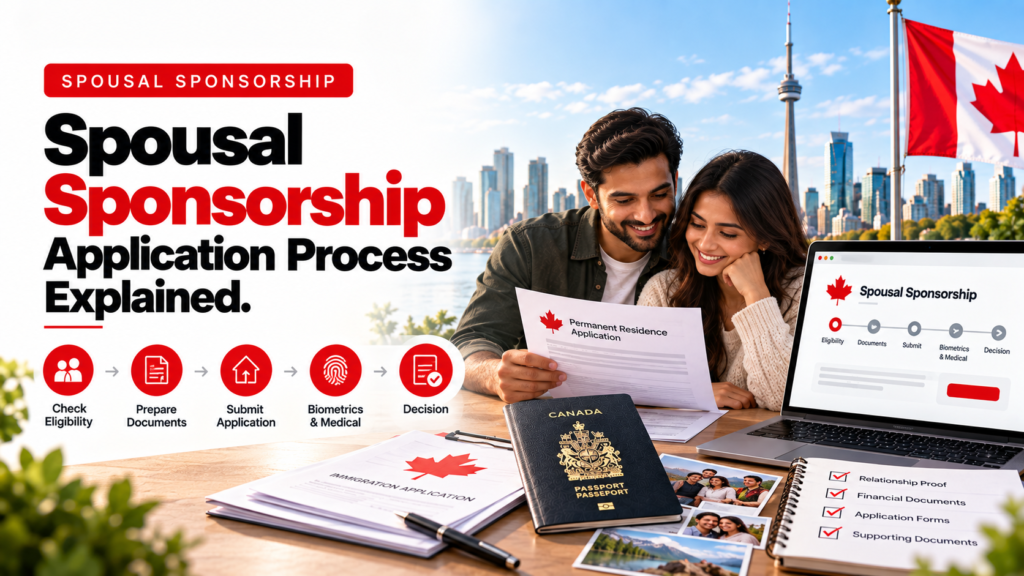
5. Step-by-Step Spousal Sponsorship Application Process
Once you understand the eligibility requirements, you can begin preparing your application.
Step 1: Gather Your Documents
Start by collecting the documents needed to prove your identity, eligibility, and relationship.
Depending on your circumstances, these may include:
- Marriage certificate, if applicable
- Passports and identity documents
- Proof of relationship and shared life
- Joint financial records, where available
- Photographs and communication records
- Previous immigration documents
- Supporting forms and declarations
The exact documents depend on your relationship category and personal circumstances.
Therefore, use the current IRCC checklist to make sure you include everything required.
Step 2: Review the Application Package
Next, visit the official IRCC website and access the appropriate spousal sponsorship application package.
Read the instructions carefully before completing the forms. Also, make sure you select the correct application process for your situation.
Following the instructions from the beginning can help prevent avoidable errors.
Step 3: Complete the Forms and Pay the Fees
Complete all required forms accurately. Check names, dates, addresses, and other personal details before proceeding.
You must also pay the applicable application fees. Depending on your case, these may include sponsorship, permanent residence processing, and biometrics fees.
Check the current IRCC fee schedule because fees can change.
Step 4: Submit Your Application
Once your forms and documents are ready, follow IRCC’s instructions to submit the application.
Before submitting, review the document checklist one more time. Make sure you have included all required forms, supporting evidence, and payment details.
A complete and accurate application can help reduce delays caused by missing information.
Step 5: Complete Biometrics and Medical Requirements
After submission, IRCC may instruct your partner to provide biometrics, including fingerprints and a photograph.
Your partner may also need to complete an immigration medical examination.
Follow the instructions and deadlines provided by IRCC. If additional documents are requested, respond within the specified timeframe.
Step 6: Wait for Processing Updates
After receiving your application, IRCC reviews the documents and assesses eligibility.
The officer may also conduct background checks or request additional information.
Processing times vary depending on the application type, location, case complexity, and other factors. Therefore, check IRCC’s official processing-time tool for the latest estimate.
Meanwhile, keep your contact information up to date and respond promptly to any requests.
Step 7: Receive a Decision
Finally, IRCC will make a decision on your application.
If approved, your partner will receive instructions for completing the permanent residence process. The specific steps depend on whether your partner is inside or outside Canada.
However, submitting an application does not guarantee approval. Your partner must meet all applicable requirements.
6. Common Spousal Sponsorship Mistakes to Avoid
Small mistakes can cause delays or create problems during processing. Fortunately, careful preparation can help you avoid many of them.
Missing Supporting Documents
First, check that you have included the required forms and evidence. Missing documents may lead to delays or requests for additional information.
Providing Insufficient Relationship Evidence
IRCC needs to assess whether your relationship meets the applicable requirements.
Therefore, provide genuine and relevant evidence that reflects your circumstances. Do not rely on a single document when additional evidence is required.
Submitting Incorrect Forms
Application forms and instructions can change. For this reason, always download the latest forms and follow the current checklist.
Choosing the Wrong Application Process
Inland and outland sponsorship have different considerations. Review your partner’s location, immigration status, and travel plans before deciding which process to use.
Forgetting to Update IRCC
Your circumstances may change while the application is being processed. If IRCC requires you to report a change, follow the instructions promptly.
Keeping your information accurate can help prevent unnecessary complications.
7. How Long Does Spousal Sponsorship Take?
Spousal sponsorship processing times can vary. Although many applicants have historically used 12 months as a general reference, this is not a guaranteed timeline.
The actual processing period may depend on:
- Whether your application is complete
- Where your partner lives
- The complexity of your case
- Background and security checks
- Requests for additional documents
- IRCC’s current workload
For the most accurate estimate, check the official IRCC processing-time tool before making travel or relocation plans.
Remember that an estimated processing time is not a promise of approval or a fixed completion date.
8. Benefits of Spousal Sponsorship
Spousal sponsorship can help couples build a future together in Canada.
Some important benefits include:
- Family reunification: Eligible couples can live together in Canada.
- Permanent residence: An approved applicant can become a Canadian permanent resident.
- Employment opportunities: Permanent residents can generally work in Canada without needing an employer-specific work permit.
- Educational opportunities: Permanent residents can generally pursue education in Canada, subject to the relevant institution’s requirements.
- A possible path to citizenship: Eligible permanent residents may apply for Canadian citizenship after meeting the applicable requirements.
Additionally, spousal sponsorship generally does not require a Labour Market Impact Assessment (LMIA) or a job offer from an employer.
However, permanent residence and citizenship each have their own eligibility requirements.
Frequently Asked Questions About Spousal Sponsorship
1. How long does the spousal sponsorship process take in Canada?
Processing times vary depending on the application and the applicant’s circumstances. Although 12 months has often been used as a general reference, you should check IRCC’s current processing-time tool for the latest estimate.
2. Can I sponsor my spouse if I am unemployed?
In many cases, yes. Spousal sponsorship generally does not have a minimum income requirement.
However, you must meet the other sponsor eligibility conditions and be able to fulfil your financial undertaking. Receiving social assistance for a reason other than disability may affect your eligibility.
3. Do I need to live in Canada to sponsor my spouse?
Permanent residents must generally live in Canada to sponsor a spouse or partner.
Canadian citizens may sponsor a spouse while living abroad if they demonstrate that they intend to live in Canada when their partner becomes a permanent resident.
4. Can my spouse work in Canada while waiting for approval?
Your spouse may be eligible to apply for an open work permit if they meet the applicable requirements.
Eligibility depends on factors such as their location, immigration status, and the stage of the sponsorship process. Approval is not automatic.
5. What happens if my spousal sponsorship application is refused?
Your options depend on the reasons for refusal and the circumstances of your case.
In some cases, you may be able to appeal to the Immigration Appeal Division (IAD). However, appeal rights and deadlines vary. Certain refusals may not carry a right of appeal.
Review the refusal letter carefully and seek qualified advice promptly if you are considering an appeal or a new application.
Conclusion
The spousal sponsorship application process can seem complicated at first. However, understanding the requirements and preparing your documents carefully can make the process easier to manage.
Start by confirming your eligibility and choosing the appropriate application process. Then, complete the forms, provide genuine relationship evidence, and follow IRCC’s instructions throughout processing.
If you are unsure about your eligibility or the documents you need, consider speaking with an authorized immigration professional.
Contact Argus Immigration to discuss your circumstances and explore your spousal sponsorship options.